"Soul in Yo Bowl"
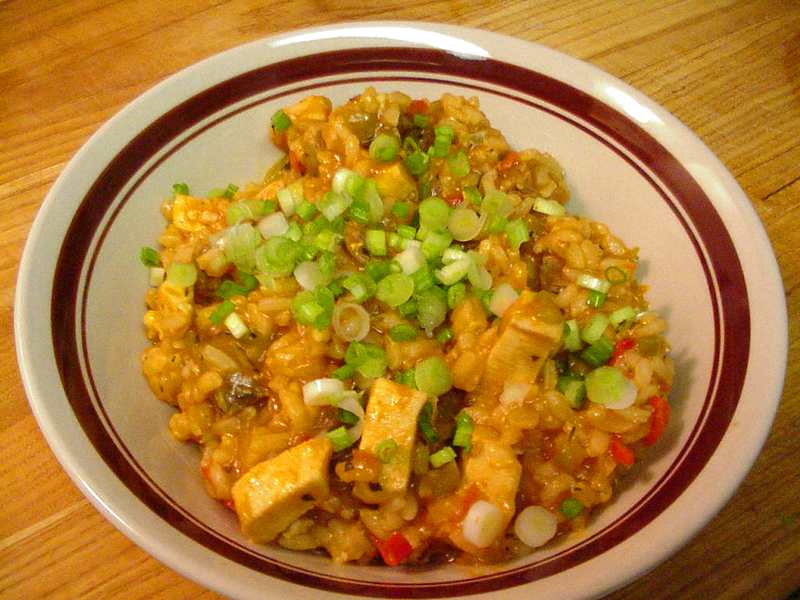
I make a good Jambalaya. I know this because most of the friends who have eaten it have lived to tell the tale. Some have even returned for seconds. And responding to a groundswell of popular demand, and for the greater common good, I feel that it is time that I should share my recipe for a Jambalaya. Vox Populi; Vox Dei and all that sort of thing, don't you know.
Ok, so the popular demand consisted of just one person but if you saw this populus, you'd know that she was all Dei.
Anyway, Jambalaya...
Jambalaya is a Cajun-Creole dish similar, in some ways to a Spanish paella or the Indian pulao (as opposed to the biryani). It originated in the swamps and badlands of Louisiana and according to Wikipedia, the Jambalaya dates back to at least 1872. Jambalaya can be made with beef, pork, chicken, duck, shrimp, oysters, crayfish, sausage, or any combination thereof or indeed from any other meat as well. If you want to throw in some 'gator in your Jambalaya, go right ahead! I make mine with a combination of chicken, Andouille sausage, Chorizo and shrimp.
But we are getting ahead of ourselves. You have to start at the very beginning, which as Maria von Trapp assures us, is a very good place to start.
And in the beginning, there is the trinity - equal parts onion, celery and bell peppers, chopped into a fine dice (about a half-cup each). The traditional trinity calls for green bell peppers but I find that just a tad too bitter and use red bell peppers instead (which also adds to the color of the dish, of course). I also throw in a few Jalapeño and/or Serrano peppers to add a little kick, but that is completely a matter of taste. The trinity should be sautéed in a dutch oven or any deep heavy pan , till the onions are transparent but not brown (deep so it can accommodate the rice and the meats without overflowing and heavy so that it retains heat. Do not use a non-stick pan, the reason for which will become clear in a minute). I prefer to use a combination of rendered bacon (pork fat rules!) and vegetable oil as the cooking medium but in these heart healthy times, use whatever oil you're comfortable with - vegetable, canola, peanut, olive; any one will do with two exceptions - extra virgin olive oil and mustard oil - because they have powerful aromas that will overwhelm the dish.
Season aggressively with crushed black pepper, cayenne pepper and Creole seasoning. If you are up to making your own Creole seasoning, here is a great basic recipe, but one can also buy this stuff pre-mixed and some of it is actually edible!
To the sautéing trinity, add the chicken and the sausages, each cut to about half-inch cubes/ slices/ dice - whatever floats your boat really. They should just be the approximate same size. It helps to use just one cut of chicken for e.g breasts (what can I say - I am a breast man!). Figure on using one chicken breast for two people. Season again with the Creole seasoning and sauté on medium heat till the chicken is browned evenly, some of the fat has rendered off the sausages and there is a good bit of 'frond' - the brown sticky bits at the bottom of the pan. The frond is critical to develop the brown color of the Jambalaya and to intensify the flavor; it is virtually impossible to develop a good frond in a non-stick pan. Enameled cast-iron is best, stainless steel is also ok, even hard anodized cookware will work in a pinch.
When the chicken has browned, add the rice (figure about a third to a half-cup per person - long grain rice works best, parboiled rice is fine) and move it around till the grains become sort of translucent. Add a couple of cloves of crushed garlic, move it around till it becomes fragrant and immediately add the cooking liquid for the rice (it happens fast in a hot pan - 30-45 secs - so watch out otherwise the garlic will burn). I like chicken stock but if you prefer fish/vegetable/ beef stock, that's fine. You can use water if you absolutely must but, be warned, it will dilute the flavors of the Jambalaya. You will need more liquid than if you were just cooking rice, so depending upon the type of rice grains you chose, you will need 2-2.5 times liquid. Use the liquid to also de-glaze the pot - scraping around the bottom to release all the frond and color and flavor contained therein.
Cook the rice as you normally would and about five minutes before the rice is done, add the shrimps (about a half-cup per) and some diced scallions. Be careful not to overcook the shrimp - when they turn pink they are done. Adjust seasonings while the Jambalaya is still liquidy and when the rice is done, so is the Jambalaya.
Eat. Enjoy.